
Choosing an electric sauna heater looks simple until you begin comparing kilowatts, room volume, glass, stone capacity, controls and electrical requirements.
The short answer is this: the best electric sauna heater is the one correctly matched to the sauna room, approved for the installation, surrounded by the required safety clearances and connected according to the manufacturer’s instructions.
For many residential saunas, the choice falls somewhere between 6 kW and 9 kW. That does not mean every medium-size sauna needs the same heater. A glass door, large window, high ceiling or uninsulated surface can increase the heating load. The exact model also determines the required circuit, controls and safety distances.
At ecosh Sauna, we treat the heater as part of the complete room rather than an appliance added at the end. The room, benches, ventilation, glass, stone mass and heater should work as one system.
Start with the decision you need to make
This guide covers heater brands, controls, the electrical questions to take to your installer, and the package supplied with an ecosh sauna. If you already have a room plan and need to calculate volume, go to the sauna heater size guide and preliminary planner.
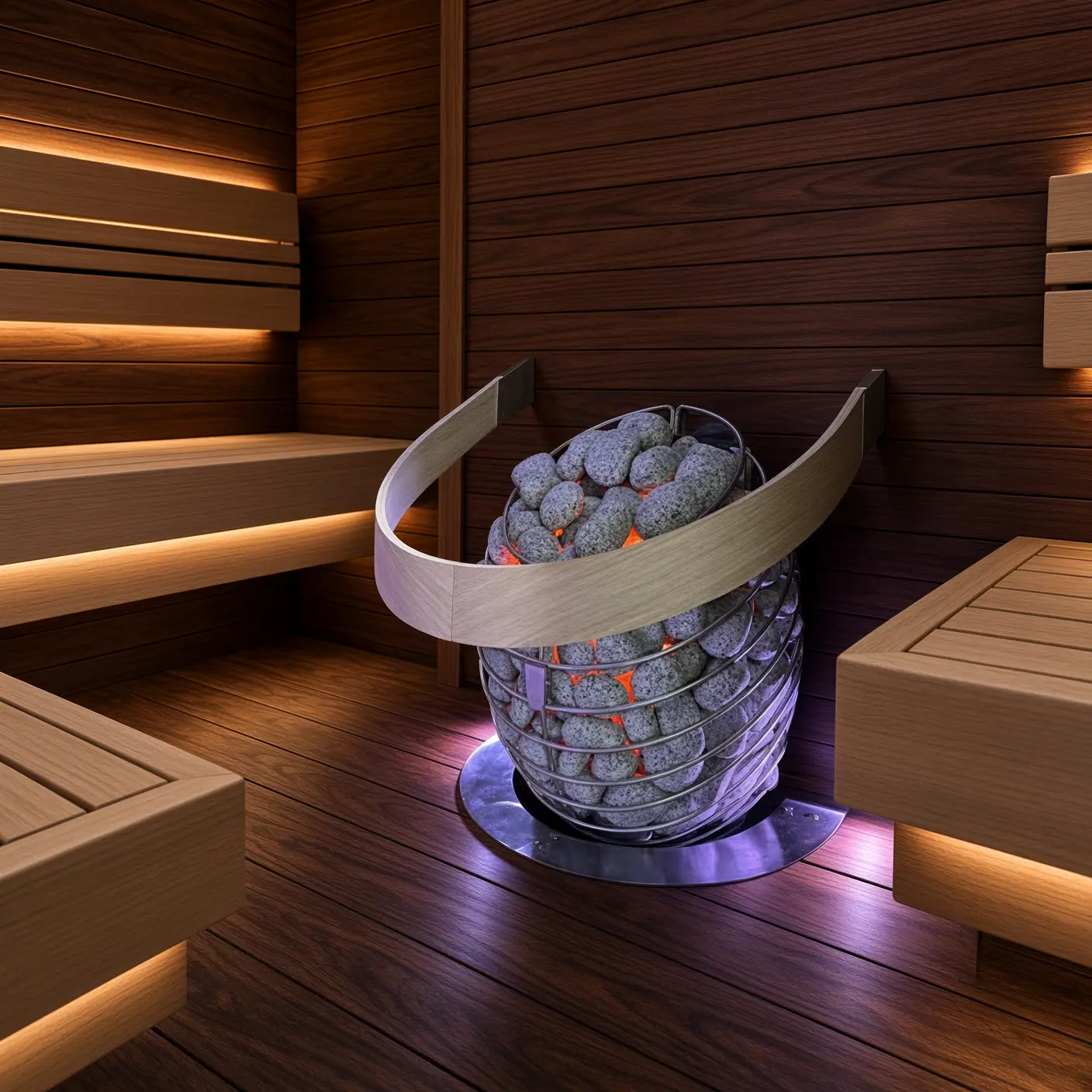
ecosh’s published modular sauna package includes a HUUM HIVE Mini 11 kW or STEEL 9 kW, a USA-version UKU 4.1 Glass WiFi control and a matching safety railing. The quote identifies the supplied combination. The 6–9 kW examples below explain general heater selection; they are not a list of all ecosh package options.
What does an electric sauna heater actually do?
An electric sauna heater uses resistance elements to heat a mass of sauna stones. Those stones store and release heat into the room. When a small amount of water is poured onto properly heated stones, it vaporizes and briefly raises the humidity and perceived heat.
This is what distinguishes a traditional electric sauna from an infrared cabin. An infrared unit primarily directs radiant energy toward the body. A traditional sauna heater warms the room and stones, allowing the bather to create steam—known in Estonia as leil and in Finland as löyly.
A good heater therefore has to do more than make the air hot. It should:
- heat the room within a reasonable time;
- maintain a stable temperature;
- hold enough stones for the desired steam character;
- suit the sauna’s size and construction;
- maintain the required clearances from walls and benches;
- work with the available electrical service;
- remain practical to inspect and maintain.
The visual design matters, especially when the heater is part of a premium interior. But appearance should never override correct sizing or installation.
How many kilowatts does a home sauna need?
Kilowatts describe the heater’s rated electrical power. More kilowatts do not automatically create a better sauna. An undersized heater may take too long to warm the room and run for extended periods. An oversized heater may warm the air quickly without giving the stones and room surfaces equal time to heat.
The starting point is the internal volume of the hot room:
Length × width × height = sauna room volume
Physical volume alone is not enough. Glass doors, windows, masonry, tile, concrete and other uninsulated surfaces increase the effective heating load. HUUM’s official sizing guidance asks users to account for glass and uninsulated surfaces and distinguishes between indoor and outdoor rooms.
| Nominal heater size | Common planning context | Important caution |
|---|---|---|
| 6 kW | Compact, well-insulated home sauna | Large glass areas may move the room beyond this class |
| 8 kW | Medium residential sauna | Use the exact manufacturer’s approved volume range |
| 9 kW | Larger home sauna or a room with a higher effective volume | Usually brings greater electrical and clearance requirements |
This is an orientation table, not a final sizing chart. Each heater model has its own approved room-volume range. Use the current North American manual for the exact product being installed.
ecosh confirms the intended heater against the final sauna configuration. Changes to glazing, room dimensions or heater position should be reviewed before installation rather than after the sauna arrives.
Why glass changes the calculation
Modern outdoor saunas often use a full glass door or panoramic front. Glass creates an open feeling and connects the sauna with the landscape, but it does not insulate like a properly constructed sauna wall. Two rooms with identical floor dimensions may therefore need different heaters.
Before selecting a heater, record:
- internal width, depth and height;
- glass door and window area;
- exposed tile, stone, concrete or log surfaces;
- whether the sauna is indoors or outdoors;
- the manufacturer’s stated room-volume range;
- expected outdoor conditions.
A California outdoor sauna may not face the same winter as one in northern Minnesota, but it still has to perform on cool evenings and in coastal weather. Correct insulation, vapor management and door sealing remain important.
HUUM vs Harvia
HUUM and Harvia are established European sauna brands, but they have different product histories and design languages.
HUUM is an Estonian manufacturer known for sculptural, stone-forward heaters and the UKU control system. Harvia is a Finnish sauna company with a broad portfolio ranging from compact wall-mounted units to floor-standing and commercial heaters.
Neither brand is automatically better for every project.
| Consideration | HUUM | Harvia |
|---|---|---|
| Origin | Estonia | Finland |
| General character | Sculptural and stone-focused | Broad range from classic wall units to column heaters |
| Controls | UKU systems, including connected options where specified | Several control families and connected options, depending on model |
| Product range | Focused heater and control collection | Broad residential and commercial range |
| Final decision | Exact room, listed model, clearances and local support | Exact room, listed model, clearances and local support |
The meaningful comparison is not simply “HUUM or Harvia.” It is one exact heater model versus another in one specific sauna. Compare the approved volume range, voltage, controls, stone capacity, mounting, safety distances, certification, warranty conditions and access to service.
ecosh’s published sauna package includes a HUUM HIVE Mini 11 kW or STEEL 9 kW heater, depending on the confirmed configuration, together with a USA-version UKU 4.1 Glass WiFi control and matching safety railing. The supplied model is written into the quote.
Why stone capacity matters
Sauna stones are not decoration. They absorb energy from the elements and release it into the room. A larger stone mass can store more heat and create a softer, longer wave of steam when the heater and room are designed for it. A compact heater with fewer stones responds differently. Neither format is universally superior.
Correct stones and placement are as important as quantity. Follow the installed heater’s manual. In general, sauna-heater stones are placed individually so air can circulate; they should not be forced tightly against the elements. Inspect the stones periodically and restack or replace deteriorated pieces at the interval specified by the manufacturer.
Does an electric sauna heater need 240V?
Most full-size residential electric sauna heaters for the North American market use a dedicated 240V supply. Some configurations may also be offered for 208V service, which is common in certain multifamily or commercial properties.
“220V,” “230V” and “240V sauna heater” are often used loosely in online searches. For an actual project, the heater nameplate and North American installation manual must match the site supply and control system.
The relationship between power, voltage and current can be illustrated with a simplified calculation:
Current = power ÷ voltage
| Rated output | Simplified current at 240V |
|---|---|
| 6 kW | 25 A |
| 8 kW | 33.3 A |
| 9 kW | 37.5 A |
These figures are not breaker or wire-size recommendations. The manufacturer’s wiring table, complete equipment configuration and applicable electrical code determine the conductors, overcurrent protection, disconnecting means and installation method. Controls, contactors, lighting and other equipment may have separate requirements.
Planning electrical work in California
A residential electric sauna heater is fixed high-power equipment. It is not normally connected to a general-purpose outlet.
Plan for:
- a dedicated circuit sized for the selected heater;
- the correct voltage and sufficient panel capacity;
- the specified control, power module and sensors;
- required disconnecting and overcurrent protection;
- the current state and local electrical requirements;
- any permit and inspection required by the local authority;
- final connection by a qualified electrician.
The local process varies by city and county. ecosh can provide the selected heater documentation and sauna specification, while the property’s licensed electrical professional verifies the final site installation.
Wi-Fi controls: useful, but safety comes first
A connected sauna control can make regular use easier. Depending on the approved system, it may allow the owner to view status, select a temperature or begin a heating cycle remotely.
Remote start requires more than an app. The full system must be installed as designed with the proper sensors and safety devices. The room must be empty and safe to heat. Towels, buckets and other objects must never be left on or close to the heater.
Before choosing connected controls, ask:
- Is the controller approved for the exact heater?
- Which door or safety sensor is required?
- Does remote operation follow the manufacturer’s North American instructions?
- Who will commission and test the system?
Convenience supports safe sauna use; it does not replace a physical check of the room.
Can you pour water on an electric sauna heater?
Yes—when the installed heater is designed for traditional sauna stones and its manual permits it. Pour small amounts of clean water onto the hot stones, not into a control unit or directly onto exposed electrical components.
Wait until the stones are fully heated. Start with a small ladle, allow the stones to recover and stop if water is not vaporizing properly. Never assume that every device marketed as a “sauna heater” accepts water; infrared emitters and other heating appliances do not work the same way.
What does an electric sauna cost to run?
Operating cost depends on heater rating, warm-up time, thermostat cycling and the local electricity price. A 9 kW heater operating at full rated output for one hour would use up to 9 kilowatt-hours during that hour. After the room reaches temperature, the elements may cycle, so session use is not simply the nameplate rating multiplied by the entire time the sauna is on.
Estimated energy cost = kilowatt-hours used × electricity rate
For a useful real-world estimate, measure the completed sauna. Insulation, glass, outdoor temperature, door opening and sizing all affect the result. We have not published measured ecosh California energy-use data in this guide, so the calculation above is an illustration rather than a promised running cost.
A reliable selection process
Do not begin with a brand logo or a desired kilowatt number. Begin with the room.
- Finalize the internal dimensions.
- Account for glass and other uninsulated surfaces.
- Identify whether the supply is 240V or 208V.
- Verify available electrical capacity.
- Shortlist heaters approved for the effective room volume.
- Compare stone mass, controls and safety clearances.
- Confirm North American documentation.
- Have the site electrician review the requirements.
- Keep the final heater specification with the project documents.
With a modular sauna, this coordination should happen before delivery. Heater position affects bench planning, guards, ventilation, sensor location and electrical preparation. That is why ecosh treats the heater as part of the sauna architecture, not a last-minute accessory.
Frequently asked questions
Is a 9 kW heater better than a 6 kW heater?
Not automatically. The heater must match the sauna’s effective volume and the manufacturer’s approved range. Too little or too much power can both create a poor result.
Does an electric sauna heater need a dedicated circuit?
Full-size residential heaters normally require a dedicated circuit. Use the exact manual and have a qualified electrician determine the final requirements.
Is a sauna heater 220V or 240V?
People search for both terms, but North American residential heater documents commonly specify 240V. Verify the nameplate and actual site supply.
Which is better, HUUM or Harvia?
Both manufacture respected European equipment. HUUM is known for stone-forward Estonian design and UKU controls; Harvia offers a broad Finnish product range. The better choice depends on the room, exact model, controls, clearances and service.
Does ecosh sell heaters separately?
ecosh Sauna’s primary offer is a complete modular outdoor sauna. We select and integrate the heater as part of the sauna specification.