
Choosing a sauna heater by floor area alone is an easy way to get the wrong result. The heater must warm the full volume of the hot room, the stones, the wood surfaces and any glass, masonry or other surfaces that lose heat faster than an insulated timber wall.
For many residential electric saunas, the decision falls somewhere between 6 kW, 8 kW and 9 kW. Those numbers are not universal room-size labels. One manufacturer’s 9 kW heater can have a different approved room range, stone capacity and installation requirements from another manufacturer’s 9 kW model.
The short answer:
- A 6 kW heater is commonly used in compact, well-insulated home saunas.
- An 8 kW heater often suits a medium residential sauna.
- A 9 kW heater is commonly considered for larger rooms or designs with more glass.
- The final choice must fall inside the room-volume range published for the exact heater.
- Glass, tile, stone, concrete and other uninsulated surfaces must be considered.
- A qualified professional must review the electrical installation using current manufacturer instructions and local requirements.
At ecosh Sauna, heater selection is part of the complete sauna design. We begin with the hot-room dimensions, construction, glass, bench layout and manufacturer specifications—not with a kilowatt number that merely sounds right.
Using this planner for an ecosh sauna
The calculator below compares physical room volume with selected HUUM DROP models as a sizing example. It does not select the heater for an ecosh order. ecosh’s published package uses a HIVE Mini 11 kW or STEEL 9 kW, with the exact model confirmed for the configuration in your quote.
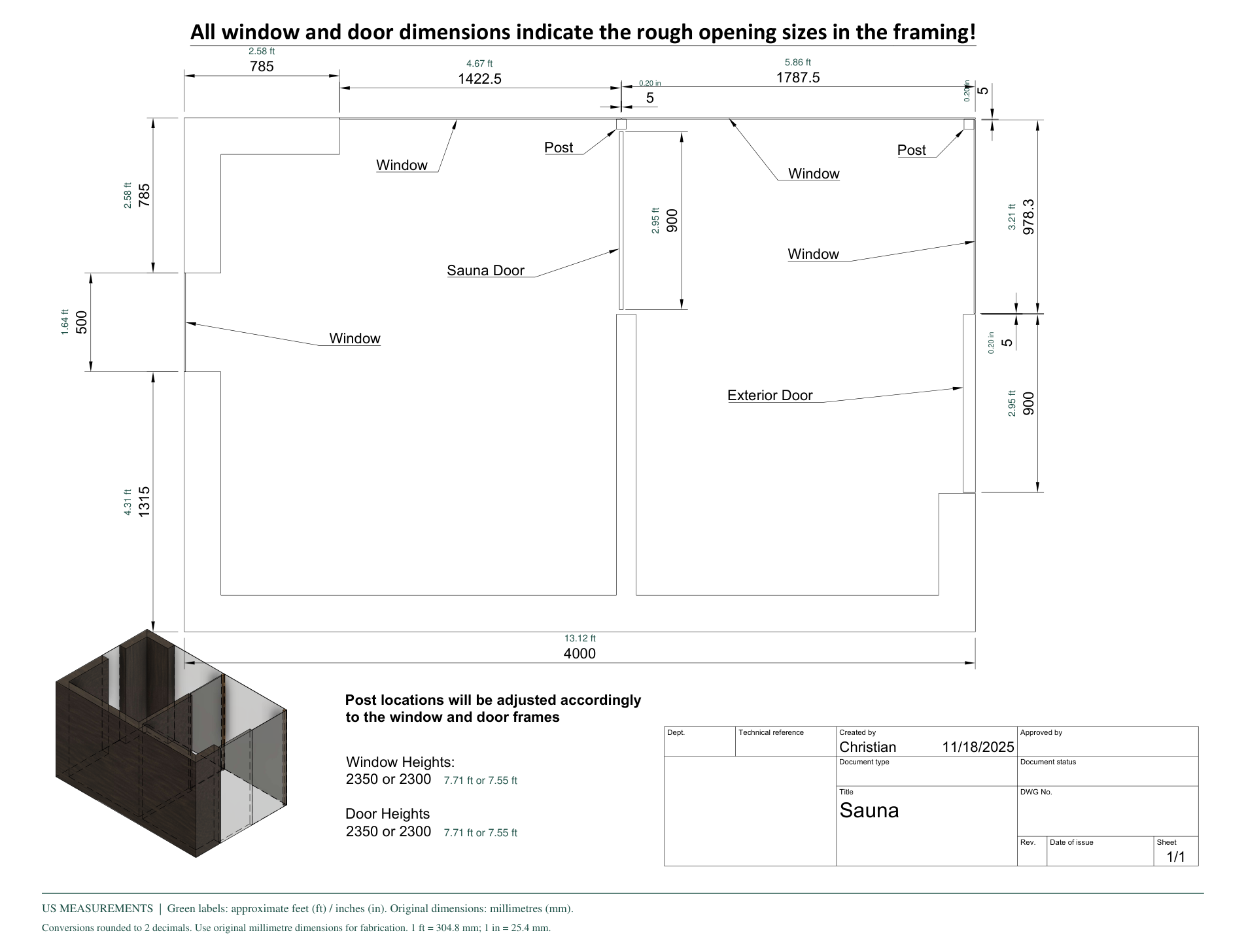
For a modular sauna, use the final interior hot-room dimensions, not the exterior footprint and not the changing room. The selected manufacturer’s method must then account for glass and relevant uninsulated surfaces. Read the electric heater guide for controls, supply-voltage questions and the installation handoff.
PRELIMINARY CALCULATOR
Sauna Heater Size Planner
Enter the interior dimensions of the heated room. The planner calculates physical volume and shows which HUUM DROP North American 240V models overlap that physical volume. Glass and exposed masonry require a separate manufacturer adjustment before a heater can be selected.
Start with the actual hot-room volume
Measure the interior of the heated sauna room—not the exterior building dimensions and not a changing room separated from the sauna.
Length × width × height = sauna-room volume
For measurements in feet, the result is cubic feet. Metric measurements produce cubic meters.
A hot room measuring 7 feet wide, 7 feet deep and 7.5 feet high has a basic volume of:
7 × 7 × 7.5 = 367.5 cubic feet
That is only the starting point. A timber room with a small glass door behaves differently from one with a panoramic glass wall. The second room has the same physical volume but a greater heating demand.
Why glass and uninsulated surfaces change the calculation
Insulated timber walls help retain heat. Glass, concrete, brick, stone and some tile assemblies increase the effective heating load because they absorb or lose heat differently.
Manufacturer instructions commonly add an allowance for non-insulated surface area. The exact adjustment is not identical across every brand and heater family, so it should not be treated as a universal internet formula.
Relevant surfaces can include:
- glass doors and windows;
- panoramic glass walls;
- exposed concrete, brick or stone;
- uninsulated tile assemblies;
- other surfaces the selected manufacturer treats as uninsulated.
Do not automatically count every tiled surface. A tiled finish over a correctly insulated sauna wall is not necessarily equivalent to exposed masonry. The construction behind the finish matters.
A safe sequence is:
- Calculate the physical room volume.
- Measure relevant glass and uninsulated surfaces.
- Apply the adjustment stated by the selected manufacturer.
- Compare the adjusted volume with the exact heater’s approved range.
- Confirm the selection with the sauna supplier and electrical professional.
6kW vs 8kW vs 9kW
The table below is a planning guide, not a substitute for a product manual.
| Heater size | Typical planning role | Common reason to consider it | Main risk |
|---|---|---|---|
| 6 kW | Compact residential sauna | Smaller, well-insulated hot room with limited glass | Too little capacity near the upper limit or with extensive glass |
| 8 kW | Medium residential sauna | More volume, higher ceiling or moderate glass | Treating 8 kW as a universal fit without checking the exact model |
| 9 kW | Larger residential sauna | Larger volume or panoramic glass | Oversizing a small room or ignoring the model’s minimum volume |
A larger heater is not automatically better. Manufacturers publish minimum and maximum room volumes. Selecting a heater for a room below its approved minimum can produce the wrong heat profile and fall outside the intended installation.
The aim is not to install the biggest heater the electrical service can support. The aim is to match the complete room with a specific approved heater.
When a 6kW heater may be enough
A 6 kW heater is often a sensible starting point for a compact, insulated home sauna with a conventional ceiling and limited glass. However, 6 kW does not define one fixed room range across the industry.
HUUM currently lists the North American 240V DROP 6 for steam rooms from 177 to 318 cubic feet. Harvia lists its Spirit SP60E 6.0 kW model for 5 to 8 cubic meters, approximately 177 to 283 cubic feet. The ranges overlap, but their upper limits are not identical.
A 6 kW option may work when:
- the hot room is compact;
- walls and ceiling are correctly insulated;
- glass area is limited;
- adjusted volume remains inside the exact model’s range;
- the layout meets every required clearance.
If the result sits directly on a model’s upper limit, do not round down without reviewing the room construction and manufacturer guidance.
When an 8kW heater makes sense
An 8 kW heater is commonly associated with medium residential saunas, but its approved range depends on the product family.
This size may enter the discussion when the room is larger than a compact two-person sauna, the ceiling is higher, the design includes more glass or a 6 kW model’s approved range is clearly too small.
An outdoor location does not automatically mean “add more kilowatts.” A well-insulated modular outdoor sauna is sized from its interior volume and construction. The complete building still has to be designed for its climate and exposure.
Before choosing an 8 kW heater, check the exact model, minimum and maximum volume, glass-adjustment method, safety distances, stone quantity, controls, voltage and current installation manual.
When to consider a 9kW heater
A 9 kW heater is often considered for a larger home sauna or a room with substantial glass. Official ranges show why the model matters.
HUUM lists the North American 240V DROP 9 for 283 to 460 cubic feet. Harvia lists the Spirit SP90E 9.0 kW for 8 to 14 cubic meters, approximately 283 to 494 cubic feet.
The nominal output is the same, but the upper limits differ.
A 9 kW model may be appropriate when adjusted volume exceeds the selected smaller model’s range, the room has a panoramic window, placement and clearances work, and the electrical professional has confirmed the installation requirements.
The 9 kW label alone does not identify the correct circuit, conductors, controls or installation method. Those details come from the exact model documentation.
A real comparison
These examples use current manufacturer-published physical room ranges. They are not interchangeable recommendations.
| Manufacturer and model | Nominal output | Published room range |
|---|---|---|
| HUUM DROP 6, North American 240V | 6 kW | 177–318 ft³ |
| Harvia Spirit SP60E | 6 kW | 5–8 m³, approximately 177–283 ft³ |
| HUUM DROP 9, North American 240V | 9 kW | 283–460 ft³ |
| Harvia Spirit SP90E | 9 kW | 8–14 m³, approximately 283–494 ft³ |
This is the central lesson: use kW as one specification, not as the complete decision. Confirm that the current version of the exact product is approved for the intended market before purchase or installation.
Is it safer to oversize the heater?
Not automatically. A heater that is too small may struggle to warm the room and stones. A heater that is too large may fall outside the manufacturer’s minimum-room specification.
A more powerful heater can also change required clearances, heater-guard design, controller selection, sensor placement and electrical planning. The correct solution is a matched system, not simply “one size larger.”
Do more stones mean fewer kilowatts?
Stone capacity and electrical output describe different parts of performance. The elements provide power. The stones store heat and produce the characteristic wave of steam when water reaches them.
A larger stone mass can change the character and timing of the experience, but it does not remove the need to size the heater for the room. Compare approved volume, output, stone capacity, heating behavior, controls and clearances together.
Electrical planning for a California sauna
Many residential electric sauna heaters for North America use a dedicated 240V supply, but the exact requirements are model-specific.
Do not select conductor size or overcurrent protection from a generic blog chart. The manufacturer’s current manual and the actual property conditions control the final design.
Before ordering, ask a qualified California electrical professional to review:
- the exact heater model and supply voltage;
- available electrical capacity;
- the route from panel to sauna;
- controller, sensor and safety-device requirements;
- applicable permits and inspection requirements.
ecosh can provide the selected heater information for planning. Final electrical design, permitting and connection remain with qualified local professionals.
How ecosh approaches heater sizing
ecosh modular outdoor saunas are planned with the room, benches, glass, ventilation and heater considered together.
- Confirm the sauna model and hot-room dimensions.
- Calculate interior heated volume.
- Account for glass and relevant uninsulated surfaces.
- Compare the result with current manufacturer specifications.
- Check placement, bench layout and safety distances.
- Provide the exact model information for local electrical review.
- Finalize the configuration before delivery.
If you compare a sauna with and without a changing room, remember that an enclosed changing room is not normally part of the heated volume. The hot room is sized separately.
Explore ecosh modular outdoor saunas, see our sauna wood and material choices or ask us about your property.
Frequently asked questions
What size heater do I need for a 300-cubic-foot sauna?
There is no brand-independent answer. A physical room volume of 300 cubic feet may fit several models, but glass and uninsulated surfaces can increase the effective sizing volume. Compare the adjusted result with the exact manufacturer’s range.
Is 6kW enough for a four-person sauna?
The number of seats is not the main sizing input. Interior length, width, height, glass and construction determine the demand. Two four-person saunas can require different heaters.
Should I choose 8kW or 9kW?
Calculate adjusted volume first, then compare it with the exact models. If both appear possible, assess stone capacity, placement, clearances and controls with the sauna supplier.
Does a glass sauna door affect heater size?
It can. Manufacturers commonly treat glass and other uninsulated surfaces as additional heating load. Measure the glass and apply the selected manufacturer’s method.
Does an outdoor sauna always need a larger heater?
No. Outdoor location alone is not the sizing formula. Interior volume, insulation, glass and construction determine the selection.
Can an online calculator provide the final specification?
No. A calculator is useful for preliminary planning. Check the result against the current manual, complete sauna design and local electrical requirements.
Can ecosh help select the heater?
Yes. ecosh considers heater selection as part of the complete modular sauna configuration. Contact us with the location, selected model and site constraints.