
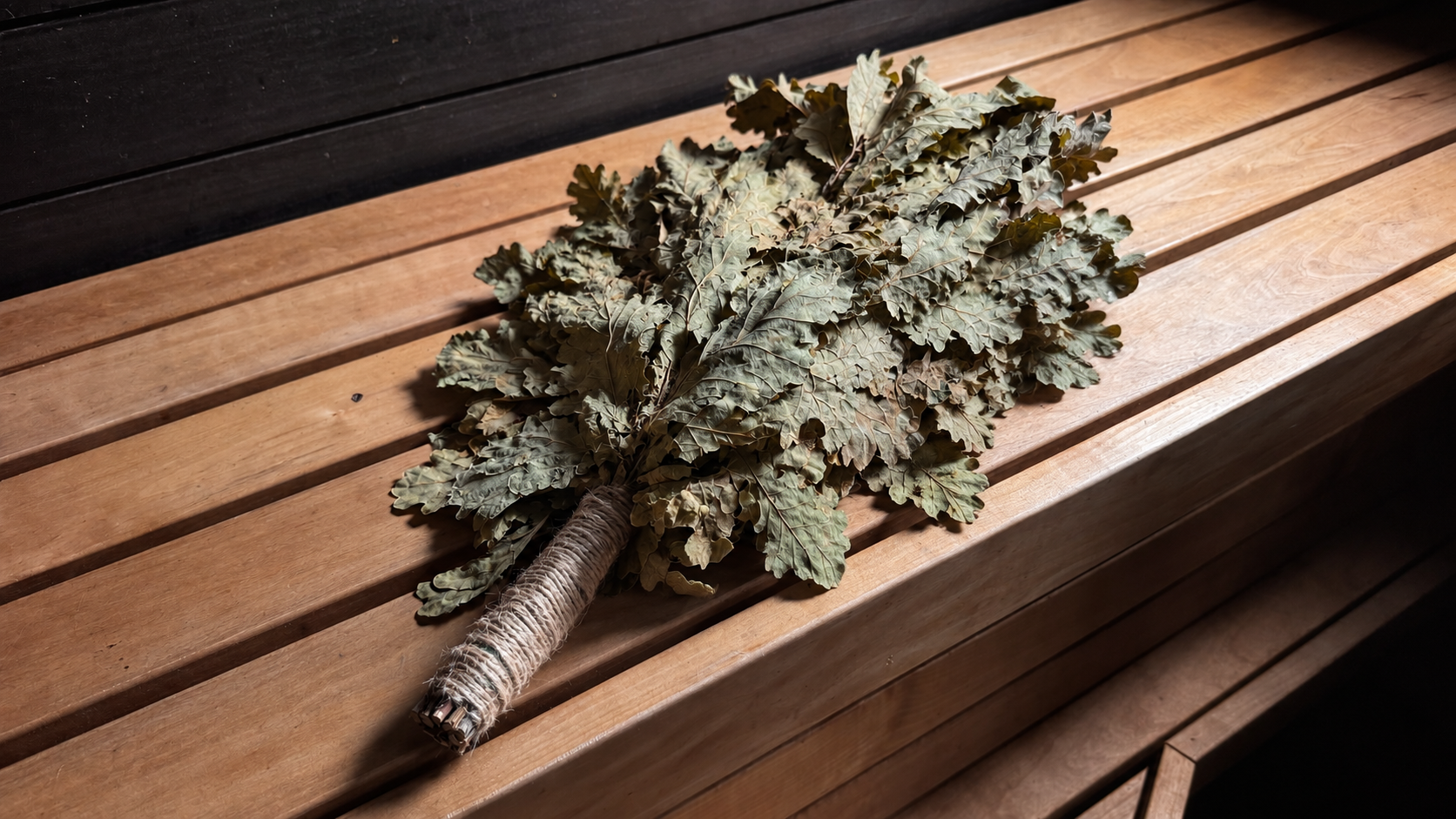
A dried sauna whisk needs time and moisture before it touches your skin. The aim is a bundle of soft leaves and flexible branches that feels comfortable to use. A damp towel offers one way to prepare it gently, with a little planning before your sauna session.
In Estonia, a sauna whisk is called a viht. If you have arrived here from the tag on your whisk, start with the quick guide below. This method is intended for a dried leafy whisk. If your product has specific preparation instructions, follow those first; fresh, frozen and conifer whisks need different handling.
What is a sauna whisk?
A sauna whisk is a tied bundle of leafy branches used for gentle brushing, light tapping and moving warm air around the body. You may also see the Finnish names vihta and vasta, or the term venik. Birch is a familiar choice in Nordic sauna culture; oak and other leafy branches are also used in different traditions.
The leaves make a soft contact surface when properly prepared. Their scent, the sound of the branches and the rhythm of the movement are part of the experience. A first session can be very gentle: there is no need to strike hard or aim for intense heat.
Drying makes a whisk easier to keep for a later sauna day, but a dry bundle is not ready for skin contact. Preparation is about bringing back flexibility before you begin.
Why use a damp towel?
The towel keeps moisture around the leaves while they soften. It also covers the outer edges that would otherwise dry quickly in warm air. The method shown in the Estonian demonstration starts with a cold rinse, then gives the wrapped whisk time to rest.
The presenter prefers this approach to a hot-water soak, describing a wish to keep the aroma in the whisk and avoid excessive heating. That is the reasoning behind this particular method, rather than a measured guarantee that it preserves more plant compounds or extends every whisk’s life.
There is more than one accepted preparation method. For example, Rento’s dried birch whisk instructions use staged lukewarm and warm-water soaking, while HUUM describes another warm-water preparation. These differences are a reason to check the instructions for your actual whisk. The practical test is the condition of its leaves and branches, not whether everyone follows the same timer.
Before you begin
Have your whisk, a clean large towel, clean cold water and a clean resting surface ready. A second towel can protect the surface beneath the damp bundle. Choose a towel without a strong fragrance so it does not overwhelm the scent of the leaves.
Remove the outer packaging. If the product includes a preparation net or special binding, follow its instructions before removing it. Check that the handle feels secure and has no sharp ends pointing toward your hand or skin. Remove loose debris gently rather than pulling at dry leaves.
Do not use a whisk with visible mold, a musty smell, slime or damaged branches that make it unsafe to handle. Softening is a preparation step; it does not make a spoiled whisk usable.
The slow preparation method
Start earlier on the day you plan to use the sauna. Rinse the leaves and branches gently with cold water. Let excess water drip away without wringing the whisk.
Wet the towel, squeeze it out, then lay it on a clean surface. Place the whisk on it and fold the fabric over the leafy part. Cover the tips as well as the center, leaving the branches in their natural shape. If you prepare two whisks, use enough towel to cover both without compressing them into a tight roll.
Let the wrapped bundle rest at ordinary room temperature, away from direct sun or a radiator. The video suggests around seven to eight hours. Check during preparation that the towel has not dried out; if necessary, dampen it again with clean water.
This is a same-day preparation method, not a way to store a damp whisk for days. When it is ready, use it for your planned session. Afterward, unwrap it and let it dry properly.
How to tell when your whisk is ready
Open the towel and gently check both the outer leaves and the middle of the bundle. The outer layer can feel softer while the center still needs time.
- Leaves: they feel pliable rather than papery, and do not crackle or crumble with a gentle bend.
- Small branches: they flex without needing to be forced.
- Handle: the binding remains secure and no sharp ends protrude into the contact area.
- Skin contact: a light brush against your forearm feels comfortable, not scratchy or painfully hot.
If it remains brittle, give it more preparation time and follow any product-specific instructions. Do not compensate for a stiff whisk by hitting harder. A badly deteriorated bundle may need replacing rather than more soaking.
Using the whisk during your sauna
Allow yourself to warm up comfortably before starting. Try a few light brushing movements or soft taps first. When using a whisk on another person, ask how the temperature and pressure feel and adjust immediately.
Keep the leafy surface against the skin rather than exposed branch ends. Avoid the face, eyes and broken or irritated skin. Stop if the leaves cause discomfort or irritation. If you know you react to the plant used in the whisk, choose another way to enjoy the sauna.
Between rounds, the video recommends returning the whisk to the damp towel so the leaf tips do not dry out. Keep it in a clean place safely away from the heater. If it becomes dirty, rinse it; covering it with a towel is not a substitute for cleaning.
Use a personal whisk rather than passing one from person to person. A rinse does not disinfect it. Take breaks whenever you need them, and keep the session comfortable rather than trying to complete a set amount of whisking.
Rinse and dry after the final round
At the end of the session, gently rinse the whisk with clean water to remove sweat and surface debris. Let excess water drain, then hang it by the handle where air can circulate around the leaves.
Choose a cool, dry, well-ventilated place outside the hot room. Do not leave it on the sauna bench, over the stove or wrapped in the damp towel. Do not seal it in a bag while it is still wet.
Once completely dry, protect it from crushing, damp conditions and direct sunlight. Before another session, inspect it again and soften it according to the relevant preparation instructions. Reuse depends on the whisk’s condition and the supplier’s guidance; there is no useful universal promise of a fixed number of sessions.
Replace it if it smells musty, shows mold, sheds heavily, has sharp broken branches or no longer becomes comfortable to use. Good care can preserve a usable whisk, but rinsing does not restore one that has deteriorated.
Mistakes that make preparation harder
Starting while the leaves are still dry. A clock cannot confirm softness. Check the middle of the bundle and the leaf tips before skin contact.
Trying to hurry with boiling water or direct heater contact. Neither is part of the towel method. Keep the whisk away from the heater and follow its own preparation instructions.
Wrapping too tightly. The towel should hold moisture around the leaves without crushing the bundle or bending the branches out of shape.
Letting the tips dry between rounds. Cover the full leafy section when resting the whisk, and check that the towel remains damp.
Leaving it wet after the sauna. A damp wrap is useful during preparation and short breaks. After the final rinse, the whisk needs air and drying time.
Frequently asked questions
How long does a dried sauna whisk take to prepare?
In the damp-towel demonstration, the suggested times are around 7–8 hours at room temperature or roughly 30 minutes on a sauna bench under supervision. Actual readiness depends on the whisk and conditions. Use soft leaves, flexible branches and comfortable skin contact as your final checks.
Should I soak a sauna whisk in hot water?
Follow your product’s instructions. This towel method begins with a cold rinse, but some manufacturers instruct users to soak their dried whisks in lukewarm or warm water. Do not assume that boiling water is appropriate.
Does this method apply to fresh or frozen whisks?
The timing here is for dried leafy whisks. A fresh whisk does not need the same rehydration, and a frozen whisk needs suitable thawing and handling. Follow the supplier’s guidance rather than applying the dried-whisk timer to either. Conifer whisks are also outside the scope of this guide.
Can I leave the whisk wrapped overnight?
The video’s room-temperature method lasts approximately 7–8 hours, which may fit an overnight preparation window. Keep the bundle clean and check it before use. Do not treat a damp towel as long-term storage; after use, rinse and dry the whisk fully.
Can I use the whisk again?
Only if its condition and product guidance allow it. Rinse and dry it after use, then inspect it before preparing it again. Discard a moldy, musty, slimy or damaged whisk. Rinsing does not disinfect it for sharing.
Why are leaves falling off?
Some loose leaves are normal, but heavy shedding can indicate a brittle or deteriorated whisk or rough handling. Check that the leaves are soft before use and begin gently. Replace a bundle that no longer holds together comfortably.
Bring a little of the forest into your sauna
The preparation is simple once it becomes part of your sauna day: rinse, wrap, allow time, and check by touch. During the session, keep the leaves supple and the movements gentle. Afterward, give the whisk the same care you gave it before the first round.
To explore the wider ritual, visit ecosh Pop-up Experience or read our guide to creating a sauna and cold plunge ritual at home.
Sources and method
The damp-towel sequence and its approximate preparation times are adapted from an Estonian-language video supplied to ecosh, bearing the creator handle @elamus.spabowling. This article draws on the visible subtitles and demonstration, with added readiness, handling and aftercare guidance. It is an editorial guide, not a verbatim translation of the video.
Further references explain why preparation varies between products and traditions: