
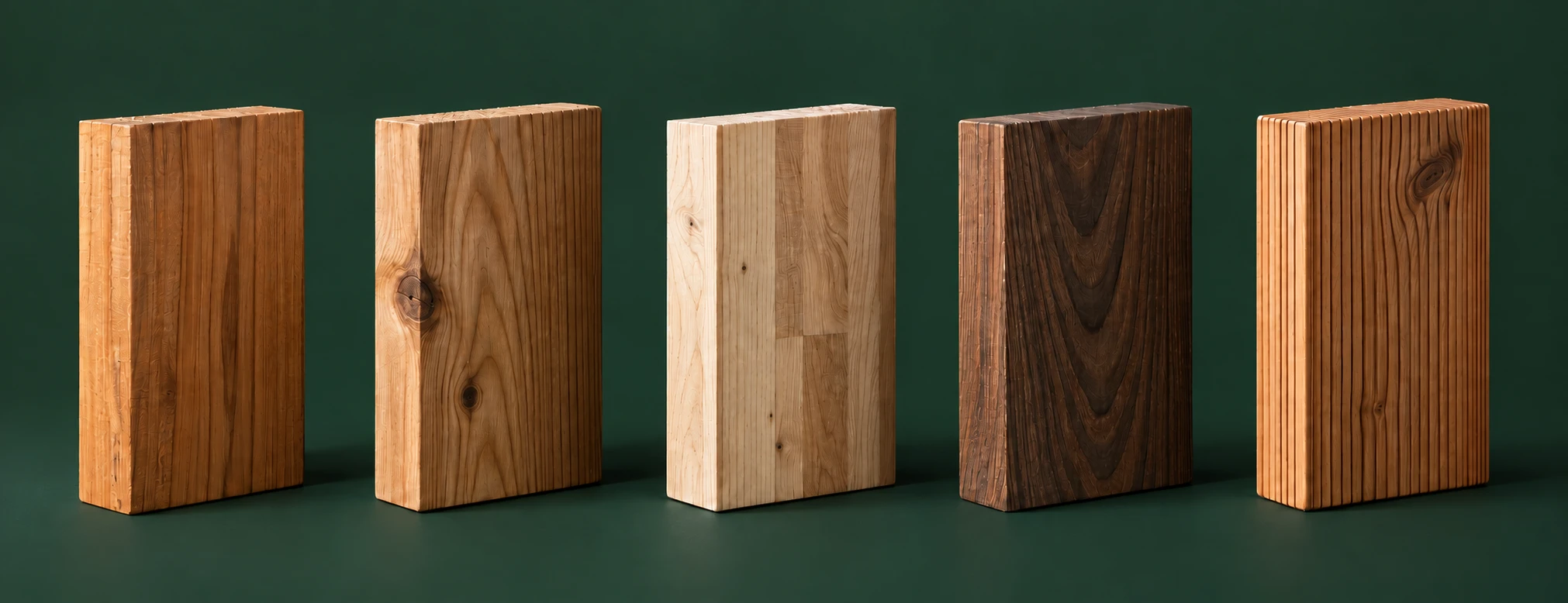
Ask three sauna builders which wood is best and you may receive four different answers. Cedar has a long history in North American outdoor construction and sauna rooms. Thermally modified wood has become a defining material in contemporary European saunas. Both can work beautifully, but they are not interchangeable—and “Thermowood” is not a single tree species.
For an outdoor sauna, the more useful question is not simply Thermowood or cedar? It is:
Which material is being used, where will it be installed, and what must that surface do?
The exterior has to manage weather. Interior boards repeatedly move between cool and hot conditions. Benches remain in direct contact with bare skin. A terrace deals with shoes, water and sunlight. A good sauna therefore often uses more than one wood, with each selected for a specific role.
Buying wood for a specific sauna surface
Start with the surface you are building: a bench, hot-room wall, exterior or terrace. Then choose the species, treatment and profile for that job. A product described as thermo-ash decking is not automatically the right board for a hot-room wall, and an attractive wall panel is not automatically suitable for seating.
ecosh’s sauna wood page separates Abachi, Thermo Spruce, Glulam, Thermo Ash and Thermo Larch by their intended roles. Send the material name, intended use, quantity or area and delivery ZIP code for a quote. Board sizes and stock availability are confirmed individually; this guide does not present an available-size list.
The short answer
For a refined outdoor sauna, thermally modified wood is a strong option because treatment can reduce moisture uptake and moisture-related movement while creating a rich tone. Western red cedar is also a legitimate sauna and exterior material, valued for its natural decay resistance, stability, light weight and distinctive appearance.
Neither name alone guarantees a good sauna.
A thermally modified board must still be the correct species, treatment class, profile and grade for its intended use. Cedar must be correctly graded, detailed, installed and maintained. For benches, ecosh offers Abachi as one material option. The selected interior's bench wood and treatment must be identified separately from the wall and exterior materials.
What does “Thermowood” mean?
Thermowood is commonly used as a general description for thermally modified wood. Strictly speaking, ThermoWood® is a registered trademark governed by the International ThermoWood Association, while other manufacturers use their own thermal-modification systems and product names.
Thermal modification is a controlled process that changes wood using elevated temperature. In the ThermoWood process, heat and steam are used; no wood preservative is added as part of the process. Treatment reduces the wood’s equilibrium moisture content and changes how readily it absorbs moisture. Depending on species and treatment, this can improve dimensional stability and biological durability.
The process does not turn every species into the same material. Thermally modified spruce remains visually and structurally different from thermally modified ash or larch. Treatment temperature, duration, original wood quality, profile and intended application all matter.
This is important when comparing prices. You are not choosing between one standard Thermowood product and one standard cedar product. You are comparing complete specifications.
What does “cedar” mean in a sauna specification?
Cedar is also a broad term. In the North American sauna market, it often means Western red cedar, but some products use different species while describing them simply as cedar.
Western red cedar has naturally occurring extractives associated with resistance to decay and insects. The Western Red Cedar Lumber Association also highlights its dimensional stability and ability to accept finishes. Its color ranges from pale honey to deeper reddish brown, and it has a characteristic aroma.
Those qualities explain its popularity for siding, outdoor structures and sauna interiors. Buyers should still ask for the exact species, grade, board profile and finish. “Cedar sauna” is not a complete material specification.
Thermowood vs cedar at a glance
| Consideration | Thermally modified wood | Western red cedar |
|---|---|---|
| What it is | Wood changed through a controlled thermal process | A naturally durable North American softwood species |
| Species | May include spruce, ash, pine, larch and others | Usually Western red cedar, but confirm the species |
| Moisture movement | Treatment generally reduces moisture uptake and related movement | Naturally stable, but still responds to moisture |
| Decay resistance | May be improved; depends on species, treatment and classification | Natural extractives provide decay and insect resistance |
| Appearance | Often deeper brown; grain and knots depend on species | Variation from light amber to reddish brown |
| Aroma | Usually more neutral after treatment | Recognizable cedar aroma |
| Exterior use | Suitable when the named product is approved for cladding or decking | Established exterior material |
| Hot-room walls | Suitable when the product is approved for sauna interiors | Common in sauna interiors |
| Bench use | Depends on species; not every board is comfortable against skin | Sometimes used, but comfort must be evaluated separately |
| Color outdoors | Uncoated surfaces generally weather toward gray | Uncoated cedar also weathers toward gray |
There is no universal winner because an exterior-cladding decision is different from a bench decision.
Best wood for an outdoor sauna exterior
The façade is exposed to California weather and should be considered as part of a complete wall assembly, not only as a decorative skin.
Thermally modified spruce can be a strong exterior-cladding choice. It retains the grain and knots of Nordic softwood while treatment reduces moisture uptake and related movement. ecosh’s material palette includes Thermo Spruce for the façade, with final profile, fixings and surface treatment confirmed for the sauna.
Western red cedar is an established exterior-cladding material. It is naturally durable, lightweight and workable. For an owner who wants cedar’s variation and aroma, a properly specified cedar façade can be attractive.
The long-term result depends on details that are easy to overlook:
- a ventilated space behind the cladding;
- correct flashing and drainage;
- compatible fasteners;
- clearance from soil and standing water;
- the manufacturer’s installation instructions;
- a realistic finishing and maintenance plan.
No wood should be sold as maintenance-free. Thermal modification does not remove the need for good construction, and natural cedar durability cannot compensate for trapped water.
Coastal and inland California need different conversations
A sauna near Carlsbad or San Diego’s coast will not experience exactly the same exposure as one in a hotter inland valley. Coastal sites can bring regular marine moisture and salt-laden air. Inland properties can experience stronger heat, intense sun and larger day-to-night changes.
This does not mean cedar is automatically better on the coast or Thermowood better inland. It means the specification should reflect the location.
For a coastal project, discuss corrosion-resistant fasteners, airflow behind cladding and drainage. For an exposed inland project, discuss UV protection, orientation, shade and maintenance of dark finishes. In both locations, uncoated exterior wood will naturally change color.
If preserving the original brown tone matters, choose a finish approved by the material manufacturer and expect to renew it. If you prefer a silver-gray surface, discuss how to let the wood age as evenly as possible.
Best wood for sauna walls and ceilings
The hot room creates a different challenge. Interior surfaces repeatedly heat, cool and encounter short periods of increased humidity when water reaches the stones.
Dimensional stability matters, but so do touch, scent, grain, color and the suitability of the selected profile. ecosh’s material palette includes Thermo Ash for selected walls and architectural finishes. Thermal modification gives ash a deep brown color and brings out its grain. The exact board must still be approved for sauna use; a general-purpose thermo-ash panel is not automatically a hot-room panel.
ecosh also presents a Glulam interior treatment. Glulam means glued laminated timber—it describes how timber is bonded, not one particular species. For sauna use, the species, construction, adhesive, surface finish and manufacturer’s intended application must be confirmed.
Cedar remains a valid alternative for sauna walls. It has a softer visual character, recognizable aroma and a long North American history. Some owners love the scent; others prefer the quieter character of thermally modified European woods.
The best decision is made by looking at real samples under warm light, not by choosing from a product name alone.
Abachi as a sauna bench material
Read the Abachi bench guide for comfort, finishes and care.
A bench should not be selected like wall cladding. It stays in contact with legs, backs and hands. It should be smooth and comfortable in heat, with rounded edges and no exposed fasteners where skin can touch them.
ecosh's material selection includes Abachi, also called ayous or obeche, for sauna benches and backrests. Abachi is a light-colored hardwood known in sauna construction for its low thermal conductivity and relatively uniform texture. These qualities make it comfortable for broad seating surfaces.
This does not mean Abachi is best for every part of the building. It is well suited to the specific job of supporting the body in a hot room.
When specifying bench wood, confirm whether it is natural or thermally modified Abachi, the final color, board dimensions, support spacing, edge shape, fastening details and care instructions. A seat towel, ventilation and drying time help any bench stay cleaner and more comfortable.
What about the terrace?
The platform outside the sauna encounters different loads again: wet feet, furniture, sunlight and water moving across the surface.
ecosh’s material palette includes Thermo Larch for the terrace. Thermally modified larch is distinct from ordinary kiln-dried larch, and the exact board profile and supplier specification must be confirmed. Surface texture, drainage, ventilation below the boards and manufacturer support-spacing rules all matter.
A terrace should never be chosen only because it matches the sauna. Ask how the surface behaves when wet, how water escapes, which fixings are required and how the color will change outdoors.
Which material looks more luxurious?
That depends more on design discipline than species.
Thermo Ash can create a deep architectural interior. Thermo Spruce can retain a Nordic character through visible knots and variation. Cedar can feel warm, familiar and distinctly West Coast. Pale Abachi benches can bring lightness and contrast to all three.
Luxury comes from resolving transitions well: boards aligned deliberately, edges finished cleanly, fasteners controlled, lighting integrated and different woods used with restraint.
Is Thermowood better than cedar?
Thermally modified wood may be stronger for a project when you want contemporary European character, deeper brown tones, reduced moisture-related movement or several coordinated species.
Western red cedar may be stronger when you want a traditional North American material, natural color variation, cedar aroma or established regional availability.
The final decision should still be based on named products, not category labels. A well-detailed cedar sauna is better than a poorly specified “Thermowood sauna.” A well-manufactured thermally modified sauna is better than cedar chosen only because the word sounds premium.
What ecosh uses
ecosh saunas use materials for distinct parts of the experience:
- Thermo Spruce for the façade;
- Thermo Ash for selected interior walls and architectural finishes;
- Glulam for the specified continuous interior treatment, with its complete construction confirmed for the sauna;
- Abachi as a bench and backrest option, with the material schedule confirmed for the selected interior;
- Thermo Larch for the terrace area.
Final species, profile, finish, dimensions and availability are confirmed in the quotation. Natural wood varies, and samples should be reviewed before the material order is finalized.
Explore ecosh sauna wood and material options or see the materials inside our outdoor sauna models.
Seven questions to ask before choosing sauna wood
- What is the exact species?
- Is it untreated, kiln-dried or thermally modified?
- Who manufactured it, and what is the named product?
- Is that exact product approved for cladding, sauna interiors, benches or decking?
- What grade, profile and finish will be supplied?
- How should it be installed and maintained in my location?
- Can I see a physical sample before confirming the order?
Those questions tell you more than asking whether a sauna is made from “premium cedar” or “premium Thermowood.”
Frequently asked questions
Is Thermowood a type of tree?
No. Thermally modified wood describes wood changed by a controlled heat-treatment process. Several species can be thermally modified. ThermoWood® is also a registered certification trademark governed by the International ThermoWood Association.
Is cedar waterproof?
No wood is waterproof. Western red cedar has natural resistance to decay and good stability, but it still absorbs and releases moisture. Design, drainage, ventilation and maintenance remain essential.
Does Thermowood need exterior maintenance?
Yes. Thermal modification can improve stability and durability, but it does not stop weather from changing the surface. Follow the named product manufacturer’s instructions.
What is the best wood for sauna walls?
There is no single answer. Thermally modified spruce and ash, cedar, aspen and alder can all be used when the exact product is suitable for the application. Consider stability, touch, scent, color, grade and sauna-use guidance.
What is the best wood for sauna benches?
Bench wood should have a smooth surface and be suitable for skin contact in the hot room. Abachi is one ecosh bench-material option, valued for its relatively low thermal conductivity and fine texture. Confirm the wood and treatment for your chosen interior.
Which is better for a California sauna?
Both material families can work when properly specified. Location, exposure, design preference and maintenance expectations should guide the choice. ecosh offers a coordinated material palette; the final species and treatment depend on the selected interior and surface.